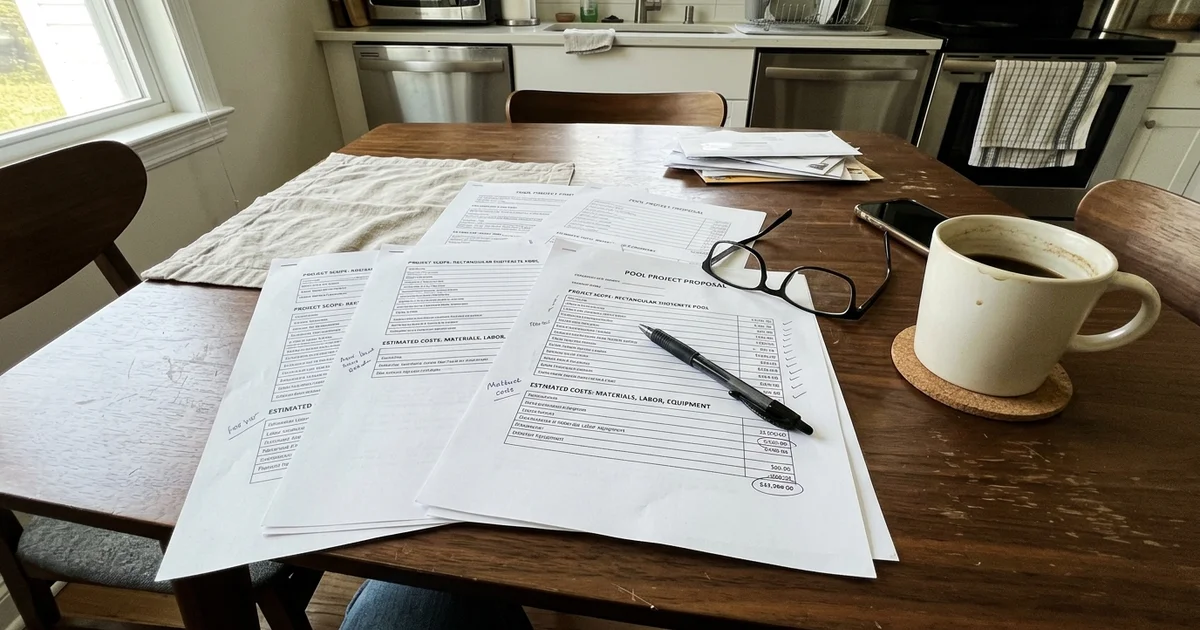
We hear the exact same frustration from property owners every single spring. Three different contractors submit their bids, and the final prices are wildly far apart.
Our team knows that a $30,000 price gap almost always means a difference in the scope of work rather than a difference in profit margins. The cheapest bid often hides missing pool quote line items that will become expensive surprise invoices by July.
We want to help you protect your budget and your backyard.
Let us break down what is included in a pool quote, the hidden costs cheap estimators leave out, and exactly how to evaluate two competing documents.
What a complete quote should actually cover
A pool quote is not just a price tag. It functions as a binding scope document. The total number at the bottom only matters if you know exactly what work it obligates the builder to perform.
Two quotes that differ by tens of thousands of dollars usually differ by scope, not by margin. As custom pool builders in Utah, our standard for a complete quote includes every single phase of the project. Missing just one of these elements guarantees a massive headache during construction.
If you are wondering what a pool estimate should include, a professional document must account for all of the following:
- Excavation and material removal: You must know how much spoil is hauled off the site rather than left in a massive pile.
- Structural construction: This includes the exact details of the concrete shell and the steel rebar placement.
- Plumbing: Your document should outline the circulation system, returns, skimmers, and specific pipe sizes for any spa or water features.
- Equipment: Look for exact brand names and models. A Pentair IntelliFlo variable speed pump performs very differently than a basic single-speed model, saving you roughly $300 to $600 annually in energy costs.
- Electrical and gas coordination: The bid needs to specify the exact trenching runs to the equipment pad.
- Decking and coping: Vague terminology is dangerous. In 2026, 400 square feet of basic broom-finished concrete might cost $5,000, while the same footprint in travertine pavers can exceed $15,000. Your quote needs the exact material and square footage.
- Interior finish: The product must be named, such as a specific pebble aggregate finish, rather than described as “standard plaster.”
- Drainage and grading: Proper grading prevents water from pooling around the pool and deck.
- Permitting: The quote must state who obtains the municipal approvals. A Salt Lake City pool building permit is valuation-based and can quickly exceed $1,000 once engineering reviews are factored in.
- Startup: This covers initial water balancing and programming the automation systems, like a Hayward OmniLogic panel.
- Site restoration: Fencing replacement, irrigation repair, and putting the landscaping back together must be fully documented.
Why Specificity Protects Your Wallet
That list is not aspirational. Every one of those items is required for a working pool in a usable yard. The only question is whether it appears in the quote or arrives later as a surprise invoice.
We advise clients to look closely at the details. Vague language is a massive red flag.
The rule that saves people money
If a line item is not written down, assume it is not included. Politely ask the builder to price it. Their answer tells you more about the bid than the total ever will.
The costs cheap estimates usually leave out
Low bids are rarely dishonest in a strict legal sense. They are just incredibly narrow. The items that most often disappear from an inexpensive Utah pool estimate are the ones that require the most heavy lifting.
Our experience shows that contractors omit these items to make their initial number look highly attractive. You will eventually pay for this work anyway.
| Commonly Excluded | Why it gets left out | What it means for you | Estimated 2026 Cost Impact |
|---|---|---|---|
| Material haul-off | Priced as “spoil left on site” | A dirt mountain in your yard to remove | $1,500 - $3,000 |
| Drainage and grading | Called a landscaping item | Runoff toward the foundation or the neighbor | $2,000 - $5,000+ |
| Retaining on sloped lots | Deferred to an engineer later | A significant change order once dug | $40-$50 per sq. ft. for boulder walls |
| Electrical and gas runs | Listed as “by others” | A separate contractor and separate bill | $2,000 - $5,000 |
| Landscaping restoration | Out of scope by definition | Finished pool, unfinished yard | $5,000+ |
| Automatic cover | Sold as an upgrade | Retrofit cost after decking is poured | $8,000 - $18,000 |
| Permitting fees | “Homeowner responsibility” | Your time and your money | $500 - $2,000+ |
None of those items are optional in practice. Slope on a Wasatch Front lot does not vanish because a contractor ignored it in their spreadsheet.
Our pool design and planning process starts with a site evaluation for this exact reason. A proper scope of work must reflect the actual property conditions rather than a generic regional template.
The Danger of Ignoring Slope and Soil
Many Utah properties require significant grading or retaining walls to create a level pool deck. Boulder retaining walls are highly popular in areas like Draper and Bountiful, but they run $40 to $50 per square foot in 2026. If a contractor defers this to an engineer later, you are staring down a massive change order right in the middle of excavation.
We constantly remind property owners to verify access paths as well. Tight yard access limits the size of the machinery, which drastically increases the timeline and manual labor costs.
How to compare two quotes honestly
Put both documents side by side and build a third column for every single item that appears in one and not the other. Then go back to the lower bidder and ask them to price each of those missing elements.
What usually happens is that the price gap narrows sharply. The remainder comes down to material quality and project management.
The Hidden Trap of Material Allowances
Ask the builder about material allowances specifically. If coping stone, water line tile, and interior finishes are carried as allowances, ask exactly what those allowances buy. An allowance set below the cost of the materials you actually want is a quiet trick to make a quote look competitive today and expensive in month four.
For example, an allowance that covers basic concrete coping will not cover premium natural stone. You need to know the price per linear foot the builder used in their math.
Coping stone typically runs $30 to $50 per linear foot. Upgrading to a premium finish later will break your budget if the original allowance was unrealistic.
Who Actually Manages the Build?
Ask who manages the construction scheduling. A builder who subcontracts every single stage has less control over sequencing. Sequencing problems are exactly where schedules slip and budgets inflate.
We perform excavation, grading, drainage, and landscaping directly to solve this issue. Most of those critical project handoffs stay inside one dedicated team rather than bouncing across four separate contracts.
Before you sign anything
Read the exclusions section of your contract twice. Confirm the interior finish product by its specific brand name, the decking material and exact square footage, the equipment models, and who holds responsibility for permitting, restoration, and drainage. Then compare the total against a realistic baseline.
Our guide to what a pool costs in Utah explains why credible custom projects start above $100,000 in 2026. This price floor reflects the true cost of quality materials, skilled labor, and comprehensive project management in today’s market.
If you would like a scoped quote for your property rather than a number from a price list, request a consultation and our experts will walk the site first.